
Private Label vs White Label Fragrance for a Hotel Line
Private label and white label are two different offers, even though suppliers and buyers often use the words as if they were one. In a white label arrangement the scent already sits in a factory's library and any other buyer can order the same juice; in private label the formula is developed or adapted for your line, and the agreement usually says something about who else can buy it. For a hotel, spa or amenity programme the difference surfaces in three places: how distinctive the scent can be, what the contract says about exclusivity, and which documents you end up holding.
Key takeaways
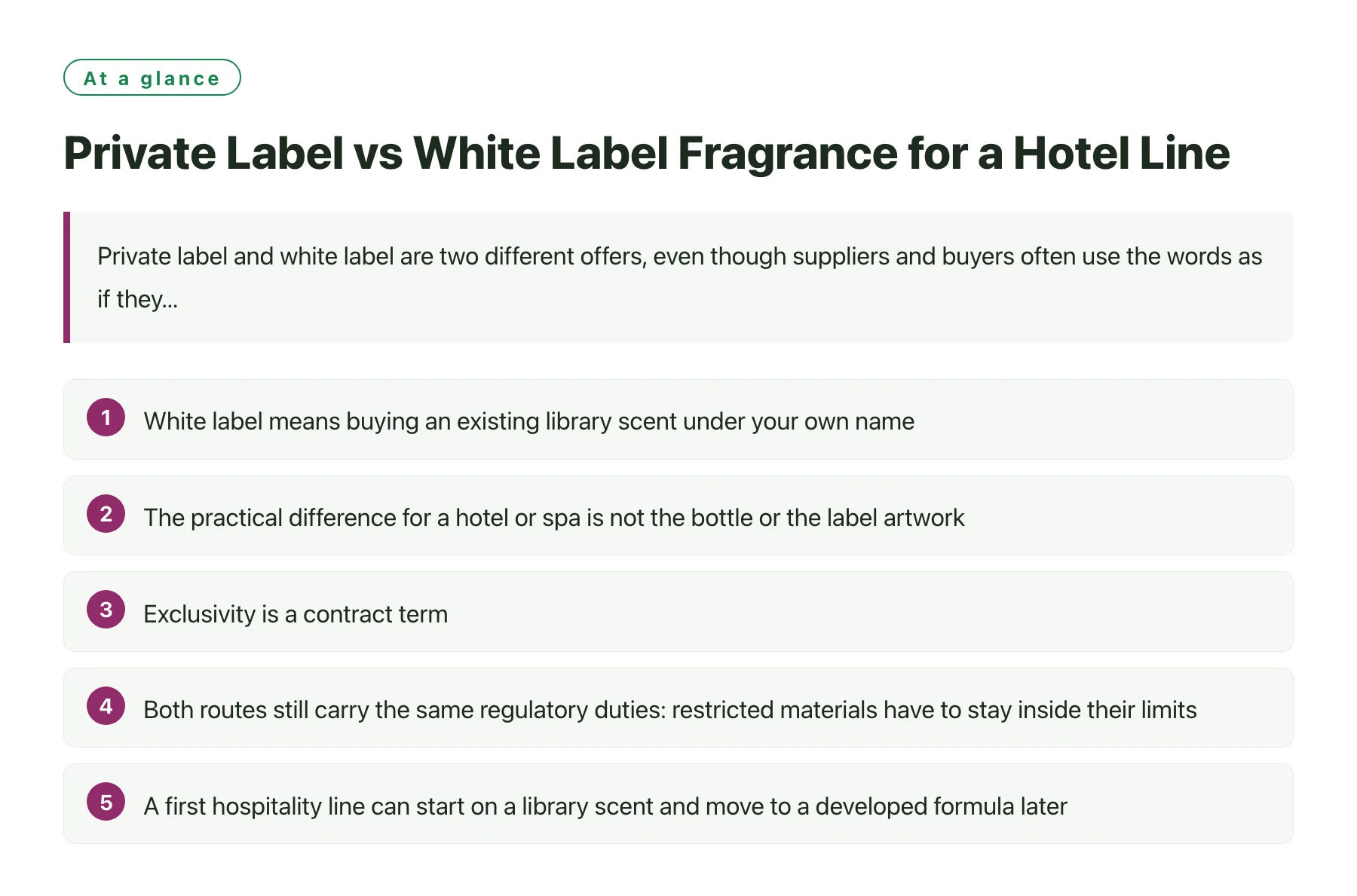
- White label means buying an existing library scent under your own name; private label means adapting or developing a formula for your line, with the commercial terms negotiated separately.
- The practical difference for a hotel or spa is not the bottle or the label artwork, which can be identical in both routes, but how many other properties can end up smelling the same.
- Exclusivity is a contract term, not a property of the manufacturing route, so it has to be written down with a scope, a territory and a duration to mean anything.
- Both routes still carry the same regulatory duties: restricted materials have to stay inside their limits, and labelling follows the finished formula rather than the sourcing model [1].
- A first hospitality line can start on a library scent and move to a developed formula later, but that transition is cheaper when the supplier records the formula and the approvals from day one.
- Trademarks and design registrations cover names and packaging shapes, not the smell itself, which is why formula control lives in the contract [2].
Hospitality procurement teams meet this question at a specific moment: the amenity range is being refreshed, the marketing team wants a scent that guests cannot buy elsewhere, and the finance team wants a unit cost that survives a multi-property rollout. The supplier's answer often arrives as a single word, private label, and the word is doing more work than it can carry.
The confusion is understandable. Both routes produce a bottle with your brand on it, both are quoted per unit, and both can be produced by the same factory on the same line. What separates them is upstream: where the formula came from, whether the supplier can sell it to someone else, and what happens when a material in it becomes restricted.
This comparison is written for a spa or hotel line specifically, because hospitality projects put unusual weight on consistency across rooms, on formats that housekeeping can actually handle, and on a scent identity that guests associate with one property rather than with a chain of them.
Where the two routes actually part ways
A white label scent exists before you arrive. It is one of the compositions a manufacturer keeps in its library, filed by family, already tested for stability in a standard base, and already priced. You choose one, approve a sample, and the project moves to packaging and filling. Speed and cost are the arguments in its favour, and for a first amenity line or a short-season property they are good arguments.
A private label project starts earlier. The brief is written, a perfumer works on candidates, the formula is refined against the base and the format, and the approved version becomes the reference for production. That development work is what the buyer pays for, and it is also what makes an exclusivity clause meaningful, because there is now something specific to be exclusive about.
The line between the two is softer than the labels suggest. Many projects begin with a library scent that is then modified: a heavier musk, a lower citrus top, a version that survives a shampoo base better than the original. That is a private label project in substance and a library purchase in origin, and the contract should describe it accurately rather than settling on whichever word is convenient.
What guests actually notice
Guests notice repetition slowly. A scent that already runs in another hotel lobby, or in a retail body care range sold at the airport, will register with frequent travellers eventually, and when it does, the property loses the association it was buying. That risk is the real argument for private label in hospitality, and it is a marketing argument rather than a manufacturing one.
It also has a limit. Two hotels can share a scent family without sharing a formula, and a supplier that offers a library with exclusivity windows or territory restrictions can often deliver a scent that is effectively unique to a market without a full development project.
What changes on the production side
Once a formula is fixed, the production line does not care whether it came from a library or from a development brief. The same filling, maceration and quality checks apply, and the same restricted-material allowances apply, because the finished product reaches skin, hair or fabric in a hotel room [1].
The difference appears when something has to change. A restricted material tightening, a carrier reformulated, a supplier of a raw material changing hands: these are events where a private label buyer expects to be consulted and a white label buyer may simply be told that the scent has been updated. Ask which of the two conversations you are buying, and ask early what one-stop fragrance manufacturing includes at that supplier, because a single contract covering compounding, filling and packaging is only an advantage if the scope is written down.
The four questions that usually decide it
| Question | White label route | Private label route | Where it leaves a hotel or spa line |
|---|---|---|---|
| Where does the formula come from? | Factory library, already tested and priced | Developed or adapted against your brief | Library gets you to market faster; development gets you a scent you can defend in marketing |
| Can another property buy it? | Yes, unless a window or territory is negotiated | Negotiable, and there is a formula to attach the clause to | This is the clause procurement should read first, because it decides whether the scent stays an asset |
| How is it priced? | Per unit, with the compound already costed | Per unit plus development and sampling work | Development is a one-off; the unit price matters more once the rollout covers several properties |
| What happens when a material is restricted? | The library formula is usually adjusted centrally | You are consulted, and the change is documented | Hospitality lines run for years, so reformulation history is worth having on file |
| What do you hold at the end? | A product, an approval record and packaging artwork | A product plus a formula record and a development file | The file is what makes a later move to another supplier survivable rather than expensive |
| Where does the format fit? | Standard bottles, tubes and refills | Standard formats, plus custom vessels if the volumes justify tooling | Amenity trays, wall brackets and refill stations constrain the choice more than the sourcing model does |
Read the table from the third column backwards. Hospitality buyers tend to start with the second question, exclusivity, and discover only later that the first and fourth determine whether exclusivity can be maintained at all. A supplier that cannot show the formula record, the stability results and the restricted-material picture is not in a position to promise much about the other three rows, which is also why what a good private label perfume factory looks like comes down to what a supplier can put on the table rather than to the size of its building.
What hospitality buyers tend to get wrong
The most expensive misunderstanding is treating private label as a synonym for exclusivity. It is not. A private label formula can be sold to another property under a different name if the contract allows it, and a library scent can be locked to one market for a set period if the supplier agrees. What you buy is whatever the agreement says, so the agreement is the product.
The second is budgeting for development but not for the work that follows it. A new formula needs stability and compatibility testing in the base it will actually live in, and hotel formats are unusually demanding: a hand wash, a lotion and a room spray based on the same scent all stress the formula differently. Third-party testing of those combinations is a real cost line, not a formality [3].
A workable hybrid for a first property
For a single property or a small group, the sensible route is often a library scent with a negotiated territory window, produced in refillable formats, with a written option to develop a proprietary version once volumes justify it. That structure keeps the first order simple and leaves the door open without paying for development twice. It is also the shape most hospitality programmes take the first time they approach Xuelei private label perfume manufacturing, because it keeps the opening purchase order small enough to approve without a board meeting.
Write the option down while the relationship is easy. Suppliers are far more willing to agree a development path at the start of a project than after two successful seasons, and the terms are usually better too.
Questions worth asking before the sample round
Ask who owns the formula record and what form it takes; ask whether the scent is currently sold under any other brand; ask what the exclusivity window covers, for how long, and in which territories; and ask what happens to the price if a restricted material forces a reformulation. Those four answers will tell you more about fit than any presentation.
The same questions apply whether you buy a library composition or commission a new one, which is the point. The sourcing model changes how the work starts, not what a well-run hospitality project has to know by the time the first order ships.
One habit makes this decision much easier to live with: keep the sourcing word out of the contract and describe the arrangement instead. Write down which formula is covered, what exclusivity means in territories and months, who holds the formula record, and what triggers a renegotiation. A contract written in plain descriptions survives staff changes on both sides; a contract that relies on the words private label is an argument waiting for a new procurement manager.
Sources
- IFRA Standards Library (International Fragrance Association) —— The IFRA Standards Library lists the restrictions the fragrance industry applies to individual fragrance ingredients, based on safety assessments; it is the reference point for compliant fragrance formulation.
- WIPO — World Intellectual Property Organization —— The UN agency for intellectual property; resources on industrial design and patent protection relevant to product and packaging design.
- SGS: Cosmetics, Personal Care & Household Testing —— Testing, inspection and certification services for cosmetics and personal care, including microbiological, stability and safety testing aligned with cosmetics GMP.
Frequently asked questions
Is white label fragrance cheaper than private label?
Usually yes, because the development work and sampling rounds have already been paid for by someone else and the unit price reflects only materials and production. The gap narrows once a private label formula is established and the development cost is spread across a long rollout, so the fair comparison is total cost over the life of the line rather than the first purchase order.
Can a hotel get exclusivity on a white label scent?
Often, if the supplier agrees to restrict that composition by territory or by channel for a defined period. What you are buying is a contractual restriction rather than ownership, so the clause needs a territory, a duration and a clear statement of whether other hospitality properties are excluded.
Does private label mean the hotel owns the formula?
Not automatically. Ownership has to be assigned in writing, and the more common arrangement is that the manufacturer retains the formula while the buyer holds rights to use it exclusively in a defined field. Both structures work; the risk is leaving the question unasked and discovering the answer during a supplier change.
How long does a private label development take compared with a library scent?
A library scent can move to packaging approval almost immediately, while a developed formula needs brief, sampling, selection and stability work before the reference is fixed. The difference is measured in sampling rounds rather than in weeks of production, so it matters most when a launch date is already committed.
What should a spa ask for when the scent is shared with other properties?
Ask for the name of the composition, the markets where it is currently placed, and confirmation of any customer restrictions. If the supplier cannot answer, treat the scent as non-exclusive and make the marketing story about the room experience and the format instead of about a scent you cannot claim.